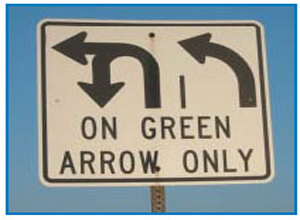
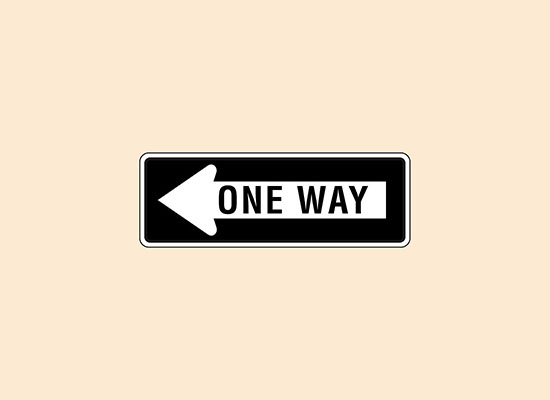
A bicyclist differs from a motorist in that he isn't required to:
- 1.Signal all turns
- 2.Obey the same traffic laws
- 3.Insure the bicycle
- 4.Report accidents resulting in serious injury
U-turns in business districts are:
- 1.Always illegal because they are dangerous
- 2.Legal at intersections, unless a sign prohibits them
- 3.Legal if the businesses are churches, apartments, or clubs
Which of the following does not happen after drinking?
- 1.Your reflexes and reaction time slow down
- 2.Your judgment of speed and distance is distorted
- 3.You are less alert
- 4.You calm down so you can concentrate
What colors are signs warning of hazards ahead, such as curves in the road or narrow bridges?
- 1.White letters or symbols on a blue background
- 2.Black letters or symbols on a white background
- 3.White letters or symbols on a green background
- 4.Black letters or symbols on a yellow background
- 1.Left or U-turn permitted on green arrow only
- 2.Left or U-turn permitted on any green light
- 3.You must turn left or make a U-turn
When a school bus is stopped and its red lights are flashing, you may:
- 1.Pass if no children are on the road
- 2.Not pass while the red lights are flashing
- 3.Pass if it is on the other side of a divided highway
- 4.Pass if you are facing the front of the bus
Driving slower than other traffic tends to:
- 1.Make an accident less likely to happen
- 2.Not change the chances of having an accident
- 3.Make an accident more likely to happen
What does a flashing yellow light mean?
- 1.Come to a full stop
- 2.Merging traffic
- 3.Proceed with caution
- 4.Pedestrian crossing
If you are parked parallel to the curb, you may get out of the car on the traffic side:
- 1.When the traffic light at the closest intersection turns red
- 2.During the daytime when other drivers can see you
- 3.If you use your four-way flasher first
- 4.When you won't interfere with oncoming vehicles
When you look ahead while driving, it is best to:
- 1.Look only at the back of the car ahead of you
- 2.Look beyond the car ahead of you
- 3.Focus on the right side of your lane
You may cross a single solid white line in the highway:
- 1.Only to turn into a driveway
- 2.Only to make a u-turn
- 3.Whenever you want to
- 4.If traffic conditions require
When looking ahead of your vehicle while driving, you should:
- 1.Look straight ahead at all times
- 2.Look only at the car ahead of you
- 3.Scan your surroundings
Look to the left and right before entering any intersection on a green light because:
- 1.Pedestrians on the cross street have the right-of-way
- 2.Once you are in the intersection, you must only look straight ahead
- 3.Other vehicles might enter the intersection against a red light
- 4.Cross traffic may have a green arrow
Lap and shoulder belt combinations in your car are:
- 1.Not effective at slow speeds
- 2.Usually safer than lap belts only
- 3.Most effective in busy traffic
- 4.Required because they help prevent accidents
What is the "basic speed law "?
- 1.Never drive faster than the posted speed limits
- 2.Never drive faster than is safe for current conditions
- 3.Keep up with the flow of traffic
When planning to pass other vehicles, you should:
- 1.Assume they will let you pass if you use your turn signal
- 2.Not assume they will make space for you to return to your lane
- 3.Assume they will maintain a constant speed
Who is responsibile for knowing how your medications affect your driving?
- 1.Your doctor
- 2.You
- 3.Your pharmacist
A diamond-shaped sign is a:
- 1.School crossing sign
- 2.Speed limit sign
- 3.Interstate route sign
- 4.Road hazard sign
What kinds of drugs, other than alcohol, can affect your driving ability?
- 1.All of these choices
- 2.Marijuana
- 3.A cold remedy
- 4.An allergy medicine
- 1.One-way street—traffic travels to the left
- 2.All traffic must turn right ahead
- 3.One-lane road to the left