When two vehicles enter an uncontrolled intersection from different highways at the same time, which vehicle must yield the right-of-way:
- 1.Neither one
- 2.Either one
- 3.Vehicle on the left
- 4.Vehicle on the right
When attempting to stop on a slippery road, you should:
- 1.Shift into neutral, do not use the brakes
- 2.Apply the brakes quickly and firmly
- 3.Apply the brakes in slow, steady strokes
- 4.Shift to a lower gear, do not use the brakes
If you are driving in the middle of a three lane expressway, and a car begins passing on your right, that driver's actions are:
- 1.OK as long as he does it on a limited access highway
- 2.Wrong because he's passing you in your "blind spot "
- 3.Wrong because "pass to the left " is a firm rule
- 4.OK if no signs forbid passing on the right
Drinking coffee after drinking alcohol:
- 1.Cancels the effect of the alcohol
- 2.Decreases blood alcohol content
- 3.Increases blood alcohol content
- 4.Has no effect on blood alcohol content
When the road has solid yellow line with a broken yellow line on your side, you may pass:
- 1.Only at an intersection
- 2.If you are on an expressway
- 3.Only in an emergency
- 4.If traffic is clear
A rectangular-shaped sign is a:
- 1.Speed limit sign
- 2.School crossing sign
- 3.Railroad crossing sign
- 4.Stop sign
If you rear-ended a car, you were probably:
- 1.Looking in your rearview mirror too often
- 2.Weaving in and out of traffic
- 3.Following too closely
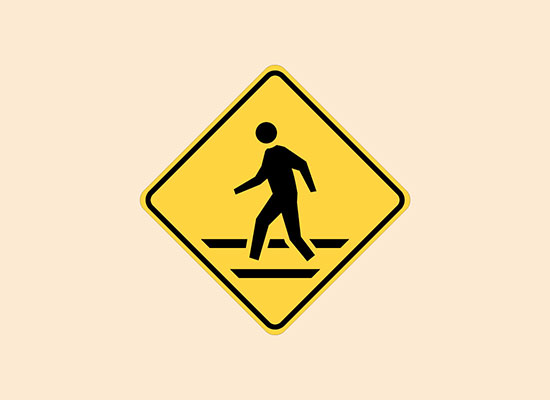
- 1.Pedestrians must yield the right-of-way ahead
- 2.Narrow pedestrian bridge ahead
- 3.There is a pedestrian crosswalk ahead
Two sets of solid double yellow lines two feet or more apart:
- 1.Denote a lane for beginning or ending left-hand turns
- 2.May only be crossed to enter a private driveway
- 3.Should be treated like a solid wall and not be crossed
Accidents are more likely to happen:
- 1.When one driver is traveling faster or slower than other drivers on the road
- 2.On bridges and overpasses
- 3.On multi-lane freeways
- 4.On city streets during rush-hour traffic
You must yield the right-of-way at an intersection to:
- 1.The car on your left
- 2.The car in the intersection
- 3.The car in the opposite lane of traffic
- 4.The car on your right
You should use your vehicle's horn when:
- 1.You are involved in an emergency situation
- 2.Traffic ahead of you is traveling below the speed limit
- 3.All choices are correct
- 4.Approaching bicyclists
You are driving 55 mph in the far left (fast) lane of a freeway posted for 65 mph. you should be cited for driving too slowly:
- 1.Under no circumstances because it is always safer to drive slower than other traffic
- 2.If the road or weather conditions warrant driving this slowly
- 3.If you block the normal and reasonable flow of traffic
Before getting out of your parked car on the traffic side of the street, you should:
- 1.Check traffic coming from behind before opening your door
- 2.Open your door so the other vehicles will stop and let you out
- 3.Give a hand and arm signal for a left turn
Who has the right-of-way at an inersection with no crosswalks?
- 1.Pedestrians, but only with the green walk signal
- 2.Pedestrians always have the right-of-way
- 3.Vehicles, but they should slow down and be careful
Improperly inflated tires can result in:
- 1.Uneven wear and additional avoidable replacement of tires
- 2.Inefficient gas mileage
- 3.All choices are correct
- 4.Blown out tires and shaking in the steering wheel
Anyone who drives a motor vehicle in the state has consented to take a chemical test for the alcohol content of his or her blood, breath, or urine:
- 1.If asked by law enforcement
- 2.Only if an accident has occurred
- 3.Only if he or she has been drinking alcohol
A pedestrian crossing at the corner has the right-of-way:
- 1.Only at intersections controlled by signals, lights, or stop signs
- 2.At marked or unmarked crosswalks
- 3.At marked crosswalks only
If your car starts to skid on a slippery road, you should:
- 1.Steer in the direction you want the front wheels to go
- 2.Steer toward the side of the road to get off the wet pavement
- 3.Lock your brakes until you come to a full stop
- 4.Brake quickly and keep the wheel straight
A green arrow pointing to the left on a traffic light means you may:
- 1.Turn left or continue going straight
- 2.Make a protected turn in that direction
- 3.Turn in that direction only after you stop