When you are driving in the left of two traffic lanes, and many cars are passing on your right, you should:
- 1.Stay in your lane so you will not impede the traffic flow
- 2.Pull onto the left shoulder to let the other vehicles pass
- 3.Move over into the right lane when it is safe
After you have passed a car you should return to the right lane when you:
- 1.Have turned your headlights on
- 2.See the car's front bumper in your mirror
- 3.Have put your turn signal on
- 4.See the other car's headlights come on
On long trips you can prevent drowsiness by:
- 1.Moving your eyes from side to side as you drive
- 2.Slowing down so you can react better
- 3.Stopping at regular intervals for a rest
- 4.Turning on your car radio
A "no standing " sign means:
- 1.You may stop to load or unload merchandise
- 2.You may stop temporarily to pick up or discharge passengers
- 3.You may park if the driver remains in the vehicle
- 4.You may never stop your vehicle
To see vehicles in your blind spots, you must look:
- 1.Over your shoulders
- 2.In your inside rearview mirror
- 3.In your side mirrors
If you get sleepy while driving, you should:
- 1.Drive to a safe place, park, remove the ignition key, and rest
- 2.Drink coffee to stay awake
- 3.Move to the right lane and continue driving
Which of the following supercedes the other three?
- 1.A stop sign
- 2.A policeman
- 3.A flashing red light
- 4.A steady red light
Tailgating other drivers:
- 1.Reduces accidents by preventing you from being cut off
- 2.Can frustrate other drivers and make them angry
- 3.Cannot result in a traffic citation
What is the best advice for driving when heavy fog, dust, or precipitation occurs?
- 1.Alternate your low and high-beams to improve your vision
- 2.Try not to drive until conditions improve
- 3.Do not drive too slowly because other drivers may hit you
You see a car approaching from the rear, but when you check your mirror again before changing lanes, you no longer see it. you should:
- 1.Look over your shoulder to be sure the car is not in your blind spot
- 2.Signal, honk your horn, and change lanes slowly
- 3.Turn your signal on and change lanes slowly
To avoid accidents, drivers should communicate with each other by:
- 1.Using emergency flashers/flares/signs as needed
- 2.Signaling when changing lanes/direction, slowing down or stopping
- 3.Using their horns in emergencies and when really necessary
- 4.All choices are correct
A red and white triangular sign at an intersection means:
- 1.Look both ways as you cross the intersection
- 2.Slow down and be prepared to stop if necessary
- 3.Always come to a full stop at the intersection
- 4.Slow down if an emergency vehicle is approaching
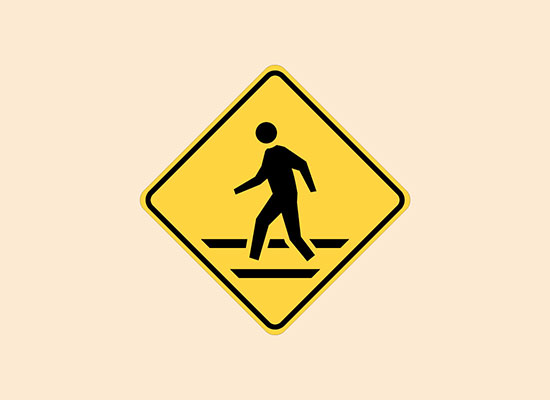
- 1.Narrow pedestrian bridge ahead
- 2.Pedestrians must yield the right-of-way ahead
- 3.There is a pedestrian crosswalk ahead
Two sets of solid double yellow lines two feet or more apart:
- 1.Should be treated like a solid wall and not be crossed
- 2.Denote a lane for beginning or ending left-hand turns
- 3.May only be crossed to enter a private driveway
A "no parking " sign means:
- 1.You may leave your vehicle unattended for less than 5 minutes
- 2.You may stop temporarily to load or unload passengers
- 3.You may park if the driver remains in the vehicle
- 4.You may never stop your vehicle
When driving on a one-way street, you may turn left onto a one-way street:
- 1.Only if a sign permits the turn
- 2.If traffic on the street moves to the left
- 3.If traffic on the street moves to the right
Most serious accidents happen at what time of day?
- 1.Afternoon
- 2.Morning
- 3.Twilight-Darkness
- 4.Serious accidents happen at about the same rate throughout the day
If your vehicle has a steering wheel lock, should you ever turn off the ignition while it is moving?
- 1.No, unless you want to coast downhill
- 2.Yes, but be prepared to skid if you step on the brakes too hard
- 3.No, the steering wheel may lock and you can lose control of your vehicle
- 4.Yes, turning off the ignition will not affect the steering control
What kinds of drugs, other than alcohol, can affect your driving ability?
- 1.Marijuana
- 2.All of these choices
- 3.An allergy medicine
- 4.A cold remedy
Look to the left and right before entering any intersection on a green light because:
- 1.Pedestrians on the cross street have the right-of-way
- 2.Other vehicles might enter the intersection against a red light
- 3.Once you are in the intersection, you must only look straight ahead
- 4.Cross traffic may have a green arrow