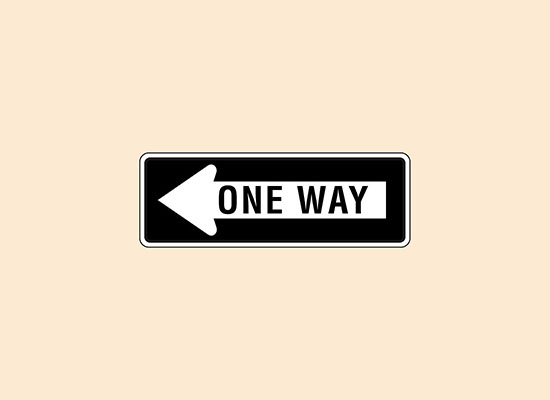
- 1.One-way street—traffic travels to the left
- 2.One-lane road to the left
- 3.All traffic must turn right ahead
To see vehicles in your blind spots, you must look:
- 1.In your side mirrors
- 2.Over your shoulders
- 3.In your inside rearview mirror
After you have passed a car you should return to the right lane when you:
- 1.Have put your turn signal on
- 2.See the car's front bumper in your mirror
- 3.Have turned your headlights on
- 4.See the other car's headlights come on
If you see warning hazard lights on a moving passenger vehicle, it means:
- 1.Pull to the right shoulder and stop
- 2.Turn your car around and drive in the opposite direction
- 3.The vehicle has the right-of-way
- 4.There may be a hazard or an accident ahead
It's best not to drive in the fog, but if you must, you should use:
- 1.Low-beam lights
- 2.Fog lights only
- 3.High-beam lights
If you exit a freeway with a ramp that curves downhill, you should:
- 1.Slow to a safe speed before the curve
- 2.Start braking when you enter the curve
- 3.Slow to the posted speed limit for the freeway
If you want to park downhill and there is no curb, which way do you turn your front wheels?
- 1.Parallel to the road
- 2.Towards the road
- 3.Towards the side of the road
Which of these statements is true about slippery road surfaces?
- 1.On cold, wet days, shade from buildings or trees can hide spots of ice
- 2.Bridges and overpasses freeze last
- 3.Pavements are not slippery the first few minutes after it starts raining on a hot day
When you drive from a private to a public road, you should:
- 1.Drive out fast to merge smoothly with the traffic
- 2.Yield the right-of-way to pedestrians and roadway traffic
- 3.Blow your horn to warn cars you are entering the roadway
- 4.Stop with part of the car on the roadway to warn other drivers
If you are approaching an intersection with a red flashing light. what should you do?
- 1.Wait for the green light before entering
- 2.Stop before entering and then proceed when safe
- 3.Slow down and allow cross traffic to go first
You may never park:
- 1.Within 50 feet of a fire hydrant
- 2.At the entrance of a building
- 3.In a crosswalk
- 4.On a one-way street
When the road has solid yellow line with a broken yellow line on your side, you may pass:
- 1.Only at an intersection
- 2.If traffic is clear
- 3.Only in an emergency
- 4.If you are on an expressway
Which of the following might cause other drivers not to see you?
- 1.Other drivers are backing out of a driveway or parking spot
- 2.Vehicle windows covered with frost, snow or ice; or sudden glare
- 3.All choices are correct
- 4.Intersections or driveways blocked by trees, vehicles or buildings
U-turns in residential districts are legal:
- 1.Across two sets of solid double yellow lines
- 2.When there are no vehicles approaching nearby
- 3.On a one-way street at a green arrow
When you are driving in the left lane of a four-lane freeway and wish to exit on the right, you should:
- 1.Carefully cross all the lanes at one time
- 2.Change lanes one at a time until you are in the proper lane
- 3.Slow before beginning each lane change
When two vehicles enter an uncontrolled intersection from different highways at the same time, which vehicle must yield the right-of-way:
- 1.Neither one
- 2.Vehicle on the right
- 3.Either one
- 4.Vehicle on the left
Drivers about to pass others should be especially careful of pedestrians and vehicles entering the road at:
- 1.All choices are correct
- 2.Shopping center entrances and exits
- 3.Crossroads, intersections and junctions
- 4.Railroad crossings and stations
You may cross a double yellow line to pass another vehicle if the line is:
- 1.Solid on your side
- 2.Broken on your side
- 3.Solid on both sides
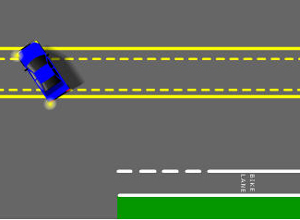
- 1.May not turn into this lane while making your left turn
- 2.May turn into this lane before merging into regular traffic
- 3.Must use this lane before merging into regular traffic
Large trucks turning right onto a street with two lanes in each direction:
- 1.Must stay in the right lane at all times
- 2.Often have to use part of the left lane to complete the turn
- 3.May complete their turn in either the right or the left lane